
We optimize. We dispatch.
You collect.
One platform that works with any manufacturer, any OEM — purpose-built for day-ahead market revenue. Not a pilot. Running. Collecting. Come see it work.
What is Asset Optimizer?
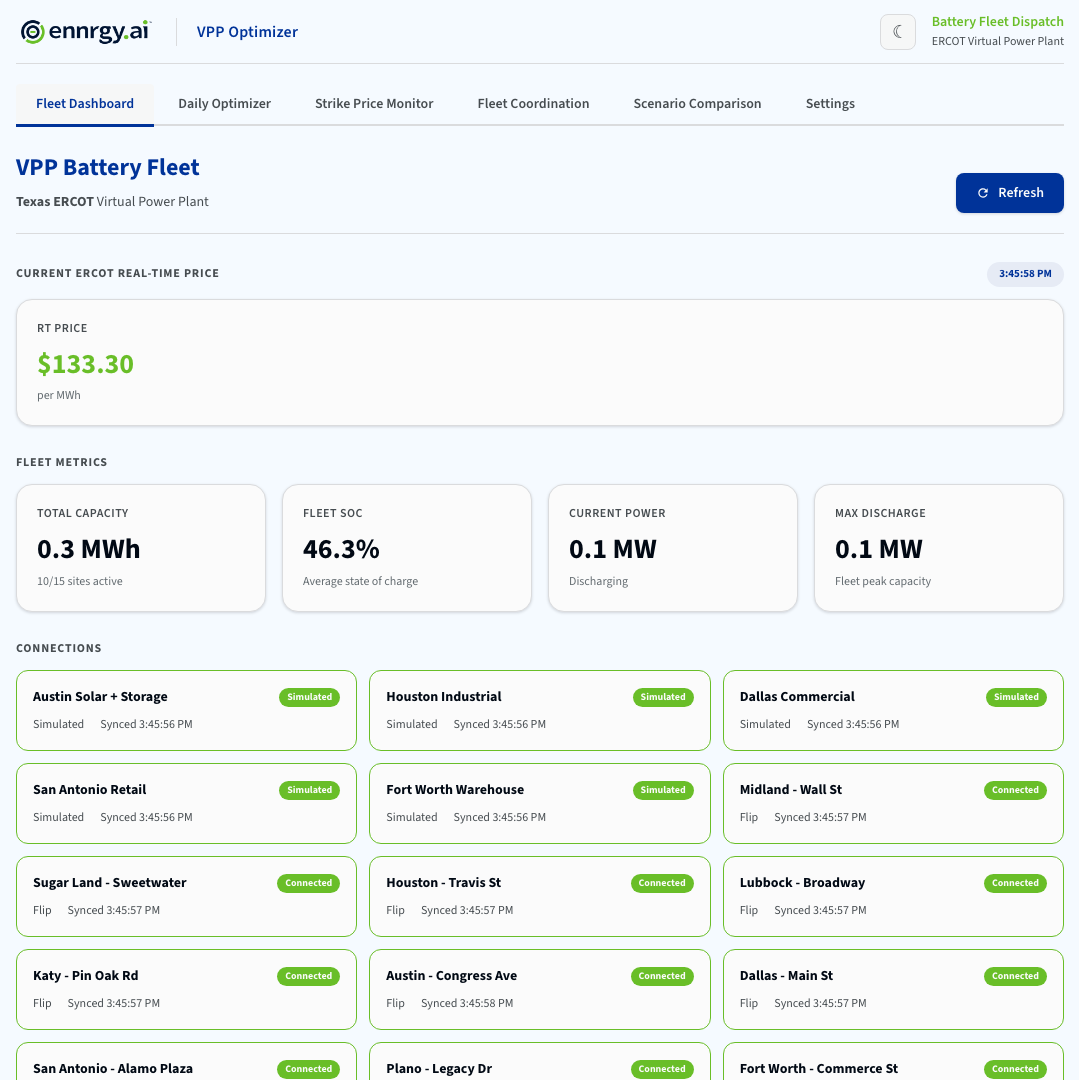
Asset Optimizer is an AI-powered battery storage optimization and virtual power plant (VPP) dispatch platform built by ennrgy.com. It automates charge and discharge scheduling for battery energy storage systems (BESS) against day-ahead energy market prices, manages state of charge with degradation modeling, and coordinates economic dispatch across multi-manufacturer fleets. Asset Optimizer is hardware agnostic — it works with any battery OEM and chemistry — and is live in ERCOT with signed customers including Abundance Energy.
Your batteries are underperforming.
And your vendor's portal isn't helping.
A single-vendor portal isn't a VPP. It's a monitoring screen with a logo on it. You're dispatching off gut instinct or manufacturer defaults — not market signals. Revenue per cycle is leaving money on the table because no one is optimizing against real-time price curves, ancillary markets, and grid conditions simultaneously. Your fleet is hardware from three different manufacturers, each with its own dashboard, its own API, its own limitations. You don't need another dashboard. You need a system of optimization.
VPP in a box. Battery agnostic.
Any manufacturer. Any OEM. One optimization platform.
Asset Optimizer is a hardware-agnostic dispatch and optimization engine purpose-built for day-ahead energy market revenue. It doesn't care what brand is on the battery. It connects to your entire fleet through a single platform — ingests market signals, models charge/discharge economics, and dispatches automatically.
This isn't a proof of concept or a pilot program. We have signed customers. Live dispatch. Real revenue flowing. The optimization runs against actual market conditions — not simulations, not backtests. Come see it work.
ennrgy.com gives us a sophisticated AI-driven operations and optimization layer that allows us to scale faster, operate smarter, and maximize the value of every distributed energy asset connected to our network.
Charge/Discharge Scheduling
Automated cycles tuned for maximum revenue — not just grid response.
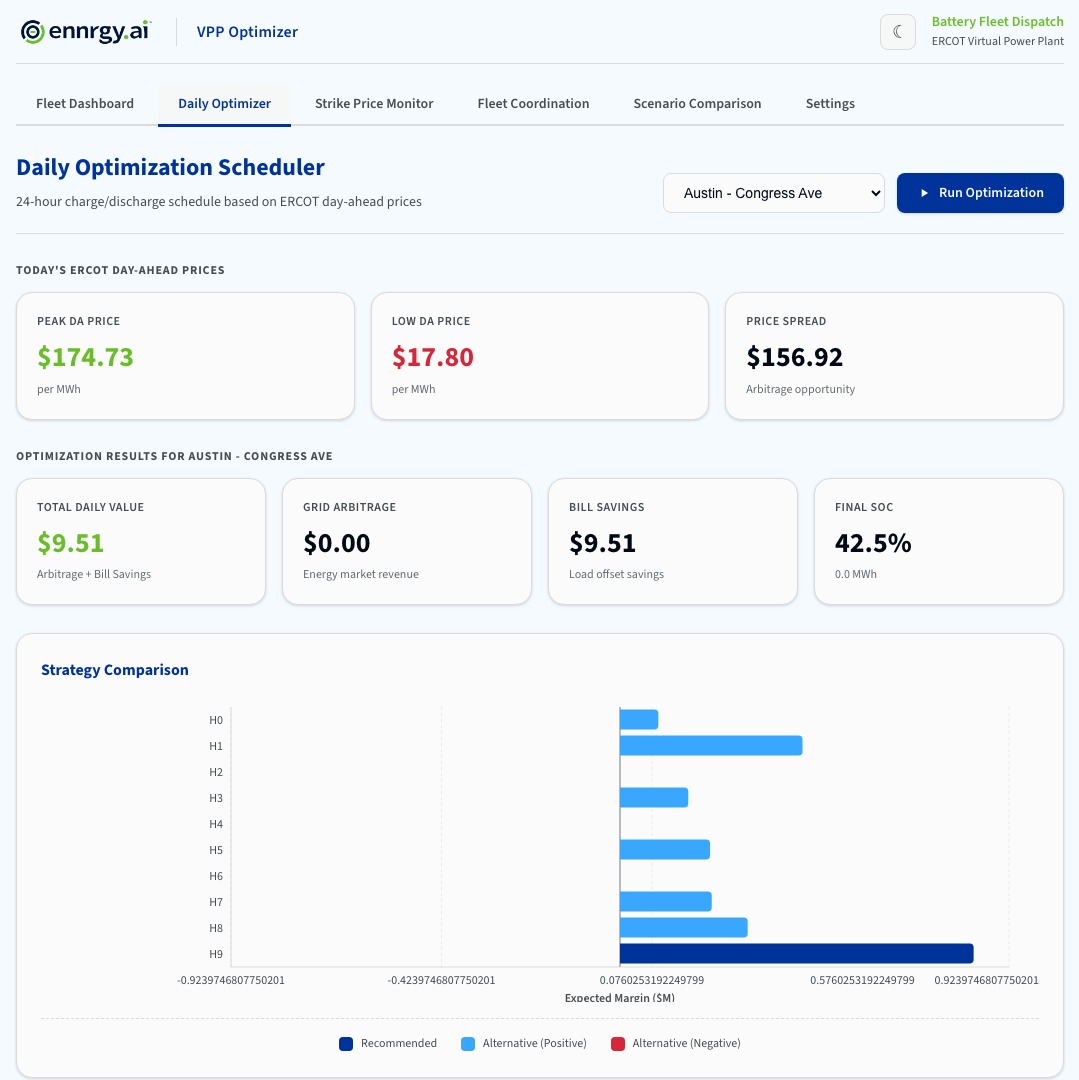
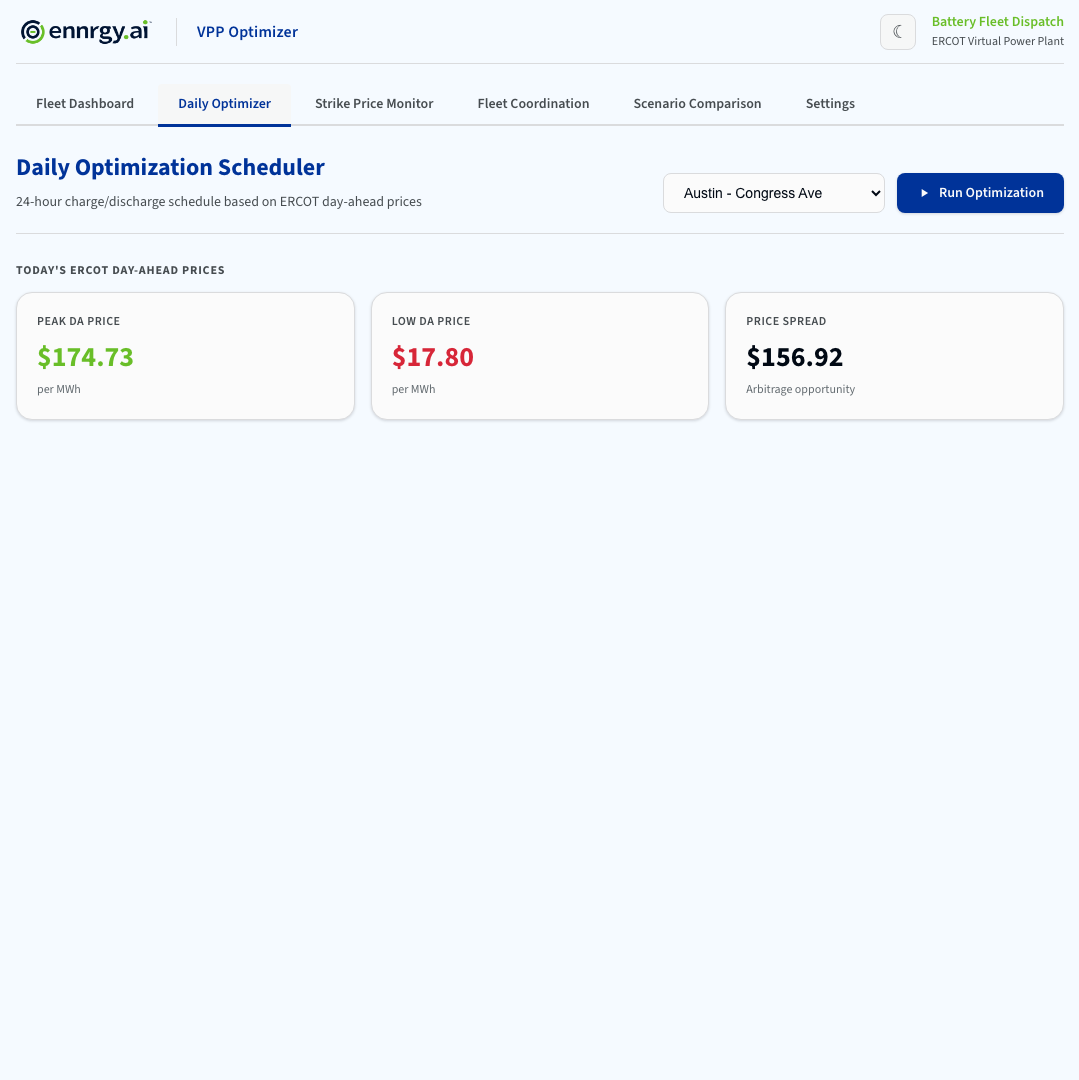
Asset Optimizer builds charge/discharge schedules optimized against day-ahead market prices, demand patterns, and grid conditions. Every cycle is timed to maximize revenue — charge when prices are lowest, discharge when they peak.
No manual intervention. No spreadsheet modeling. The engine ingests real-time price curves and dispatches automatically, adjusting as conditions shift throughout the day. Revenue per cycle goes up. Time spent managing goes to zero.
- Day-ahead price curve optimization for every charge/discharge cycle
- Automated scheduling with real-time adjustment capability
- Revenue-per-cycle tracking and performance attribution
- Manual override available when you need it
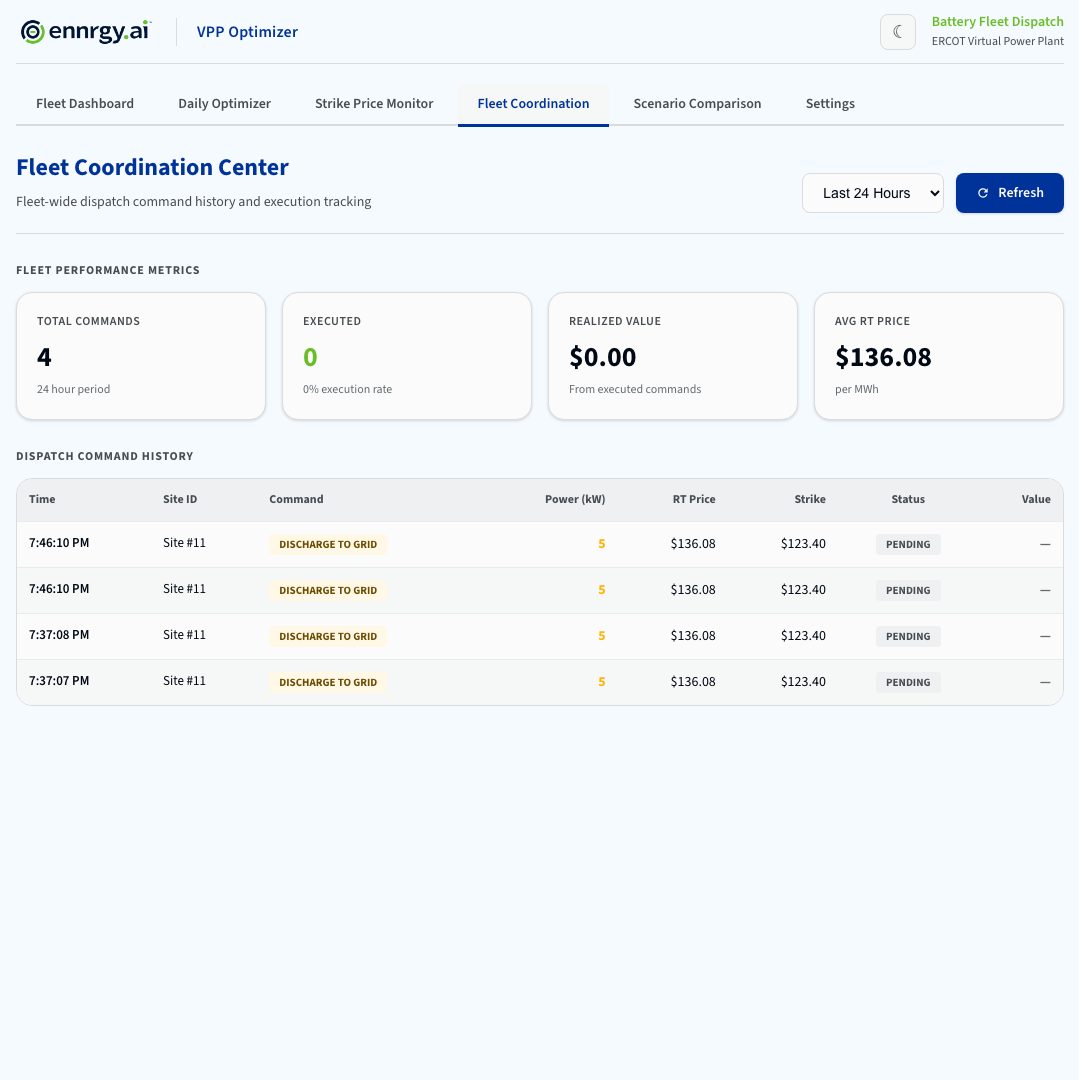
State of Charge Management
Balance revenue now against battery health forever.
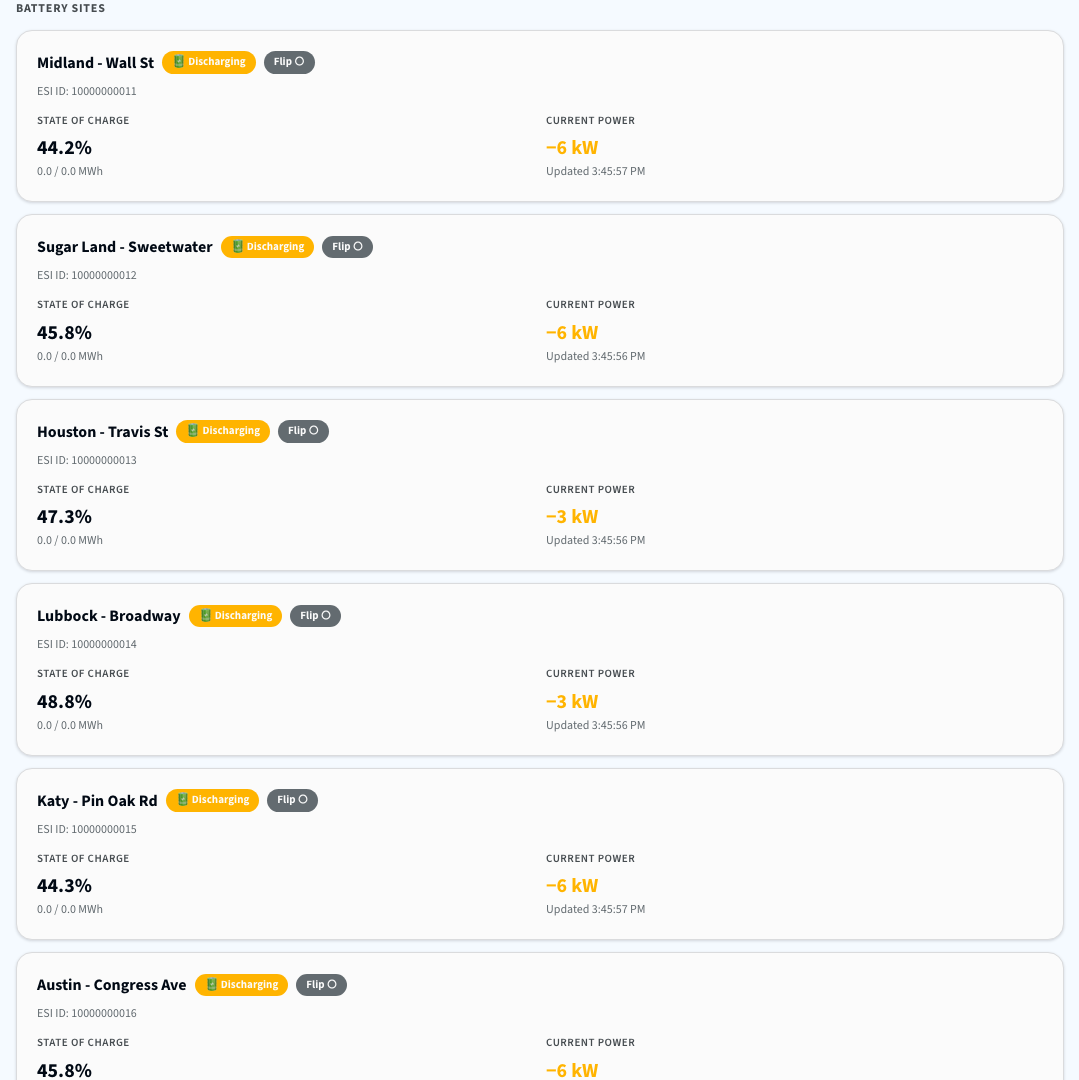
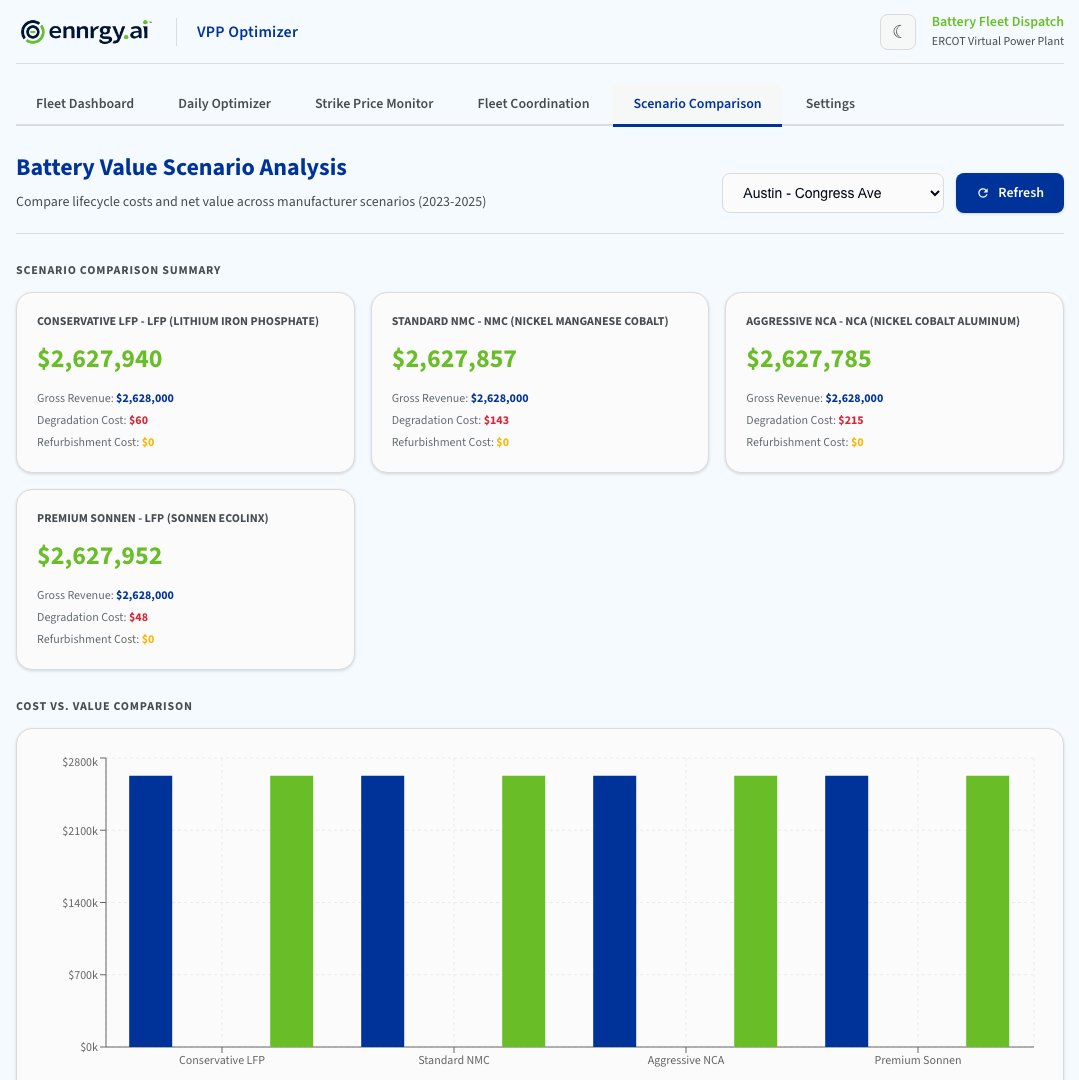
Every dispatch decision has a cost beyond the electricity — battery degradation. SOC Management monitors your entire fleet in real time, balancing immediate revenue opportunities against long-term battery health and contractual obligations.
The system tracks state of charge across every asset, flags when thresholds approach, and factors degradation curves into the optimization model. You're not just maximizing today's revenue — you're protecting the asset that generates tomorrow's.
- Real-time SOC monitoring across your entire fleet
- Battery health indicators and degradation modeling
- Contractual obligation threshold tracking
- Automated SOC balancing within optimization constraints
Economic Dispatch
Market-aware decisions that respond to price signals in real time.
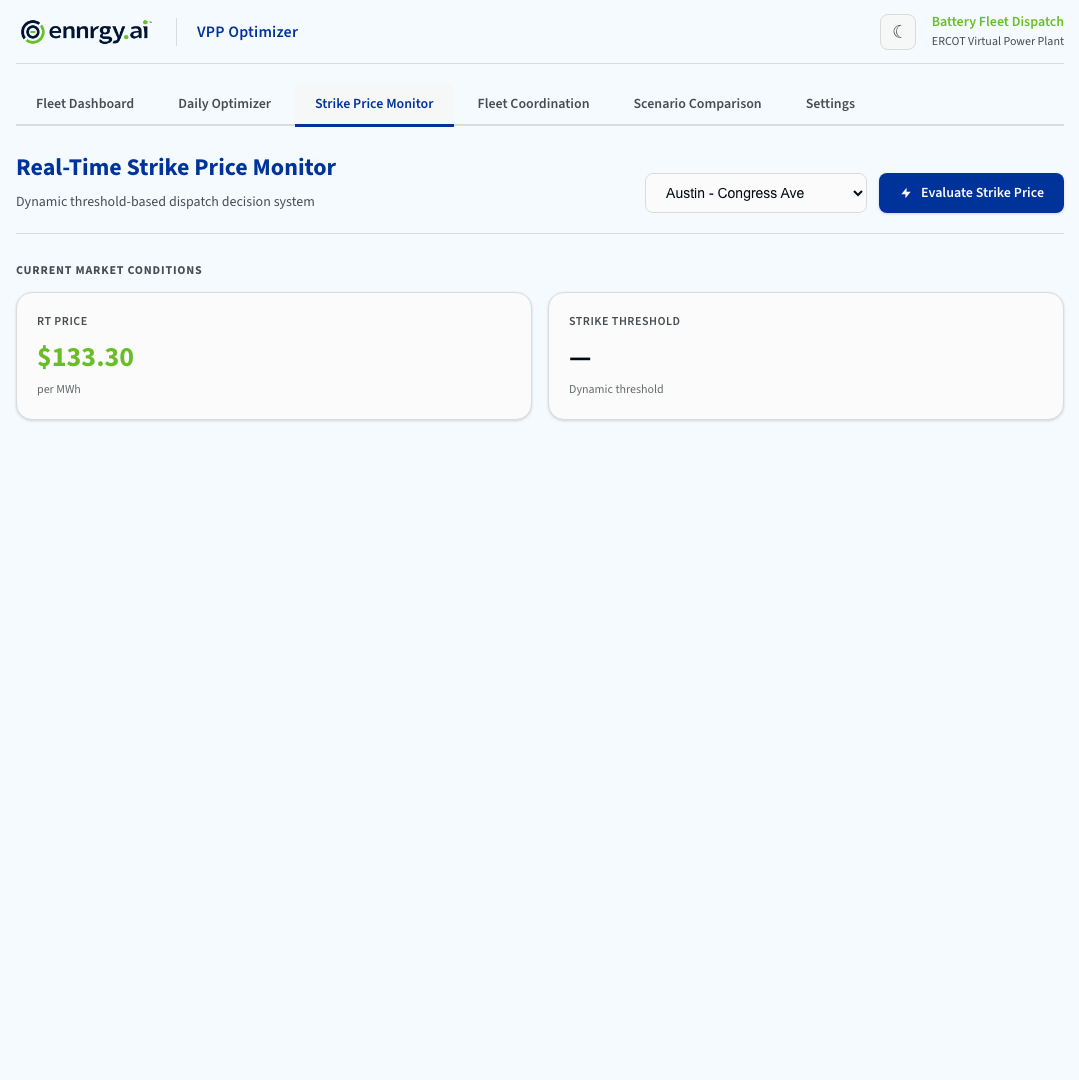
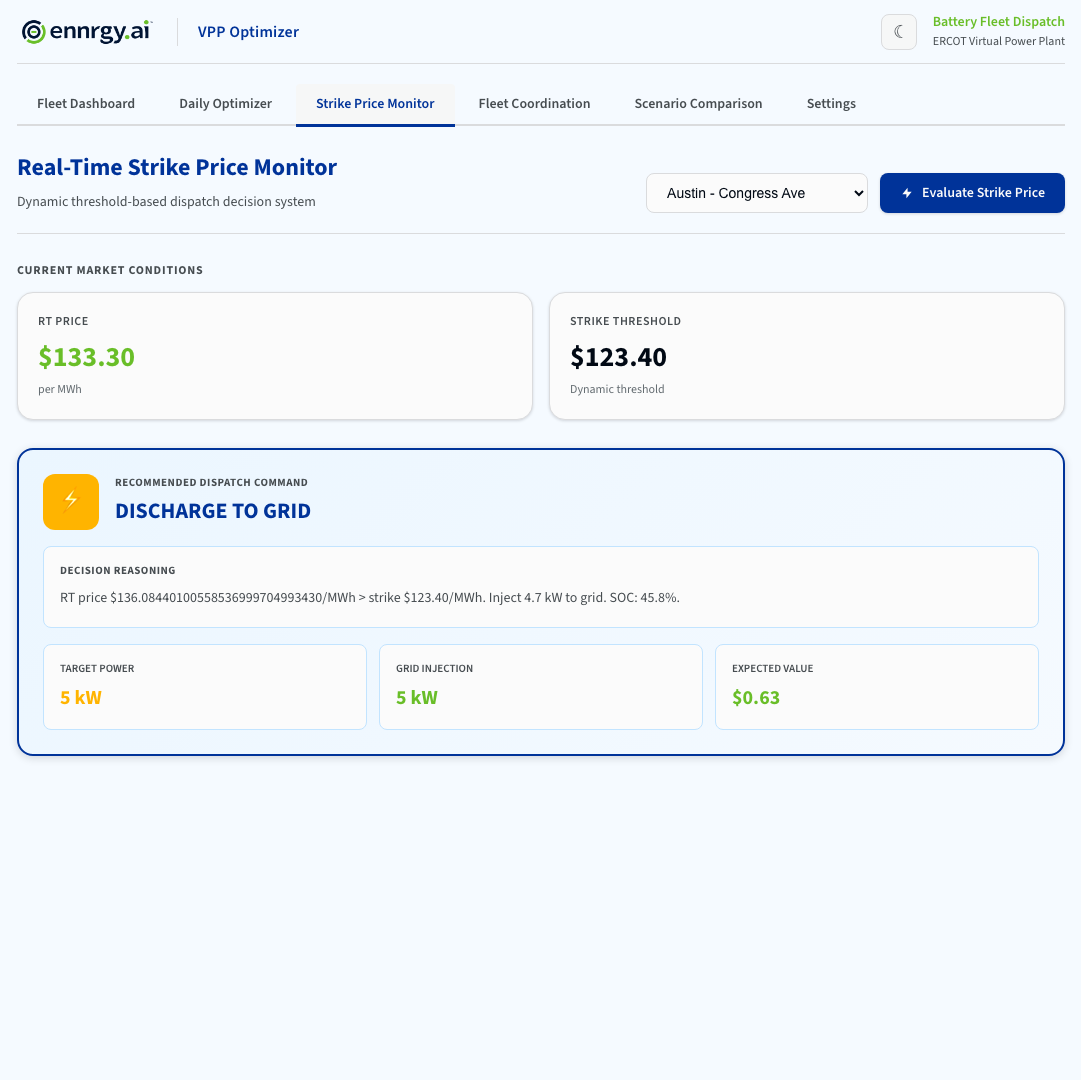
Economic Dispatch is where the optimization engine earns its keep. It evaluates market price signals, ancillary service opportunities, and grid conditions simultaneously — then makes dispatch decisions designed to maximize every amp-hour.
The system doesn't just react to current prices. It models forward curves, anticipates demand peaks, and positions your fleet to capture the highest-value dispatch windows. When ancillary markets pay more than energy markets, it pivots. When grid conditions create premium pricing, it's already there.
- Simultaneous optimization across energy and ancillary markets
- Forward curve modeling for anticipatory dispatch
- Grid condition monitoring and premium pricing capture
- Real-time market pivot when conditions change
Manufacturer Agnostic
One optimization layer. Any hardware stack. No vendor lock-in.
Your fleet isn't one manufacturer. It's three, maybe four — different chemistries, different APIs, different control systems. Asset Optimizer doesn't care. It connects to every asset through a unified integration layer and optimizes the fleet as a whole.
No vendor lock-in on the intelligence side. No separate dashboards per OEM. One fleet view with unified performance metrics, regardless of who built the hardware. Your optimization strategy shouldn't be dictated by your procurement decisions.
- Unified fleet view across all manufacturers and chemistries
- Single optimization layer regardless of hardware
- Standardized performance metrics across OEMs
- API-first integration — add new assets without new dashboards
The decision layer is where the money is
A retail electricity provider in ERCOT signs up thousands of homes with batteries. Every fifteen minutes, each one of those batteries should be charging, holding, or discharging. Get it right and the fleet earns. Get it wrong and you have bought a very expensive way to move electricity around a garage.
Put like that, it sounds like a scheduling problem. Set some time blocks, charge overnight, discharge at the evening peak, done. That is what most of the market sells — and it is why most distributed fleets underearn.
An aggregated distributed energy resource (ADER) program in ERCOT needs more than scheduling. It needs a decision layer that can see market prices, weather, load, state of charge, and your hedge position all at once — and act on all of them every fifteen minutes.
The Four-Part Value Chain
▼ What We Do ▼
Different decisions.
GUI time blocks
~50%
peak state of charge under manufacturer scheduler time blocks
Direct API optimization
~95%
peak state of charge on the same batteries, with deeper discharge troughs
Nothing physical changed. The hardware did not improve, the sun did not get better, the market did not shift. The only variable was what decided the move.
A note on what we are not going to tell you. We are not going to put a dollar figure on that gap yet. The attribution work — separating what the fleet earned under our control from what it earned under someone else’s — is still in progress, and a number produced before that analysis lands would be marketing, not measurement. When it is finished we will publish it with the method attached. Until then, the behavior is the claim.
What actually decides the move
Per-meter modeling
Load forecast at the individual meter, solar modeled per array, battery characteristics per unit. Built bottoms-up from Smart Meter Texas.
Hedge + dispatch, together
A battery reshapes the load you hedge. Modeling both in one system keeps you from hedging load that never shows up.
Direct API control
Schedules become validated API calls, not GUI time blocks. The translation step is checked, so failures are never silent.
Data operations
Telemetry retained per battery, identity mapping kept current, enrollment pipelines refreshed, staleness detection always on.
Settlement in dollars
Intervals become billing determinants — bidirectional across ESG, Vertex One, and homegrown platforms — with control attribution.
Any OEM, one layer
Proven in production on Sonnen and on Flip, including Duracell hardware via the Flip API. No vendor lock-in.
In production, not in a pitch deck
Abundance Energy
Texas retail provider, residential battery fleet, ERCOT
ennrgy.com provides Abundance’s risk management, scheduling, and battery charge/discharge optimization: the decision and settlement layers. The battery hardware and its vendor control layer come from the manufacturer side of the stack.
“As we continue scaling our residential battery storage and virtual power plant programs across ERCOT, we’re building far more than a traditional retail energy company — we’re building an intelligent energy platform that helps homeowners lower costs, improve resilience during outages, and actively participate in supporting the grid.”
Thomas Mandry — CEO, Abundance Energy
POWERED BY
Built on the Risk360 data layer.
Asset Optimizer runs on the same Risk360 data backbone that powers our Retail Pricing Platform and the rest of the ennrgy.com intelligence suite. Market data, ISO connectivity, and position management — all feeding the optimization engine in real time.
Frequently Asked Questions
What types of battery storage does Asset Optimizer support?
How does Asset Optimizer decide when to charge and discharge?
What is a virtual power plant (VPP)?
What is an ADER in ERCOT?
What is the difference between fleet software and an optimization platform?
How does battery optimization affect a retailer’s hedge book?
Where is Asset Optimizer currently operating?
How we compare
Evaluating battery dispatch platforms? See how Asset Optimizer compares to AutoGrid, Fluence, Tesla, and Stem.
See your fleet through Asset Optimizer.
30 minutes. Your assets. Your markets. We'll show you what optimized dispatch actually looks like — with real numbers, not projections.
Talk to Our Team →