
What an ERCOT battery-duration curve tells you, and the part it leaves out.
Duration is the battery question everyone in ERCOT is arguing about: how many hours should you build? The market has been answering it in real time, and the answer is more interesting than "more."
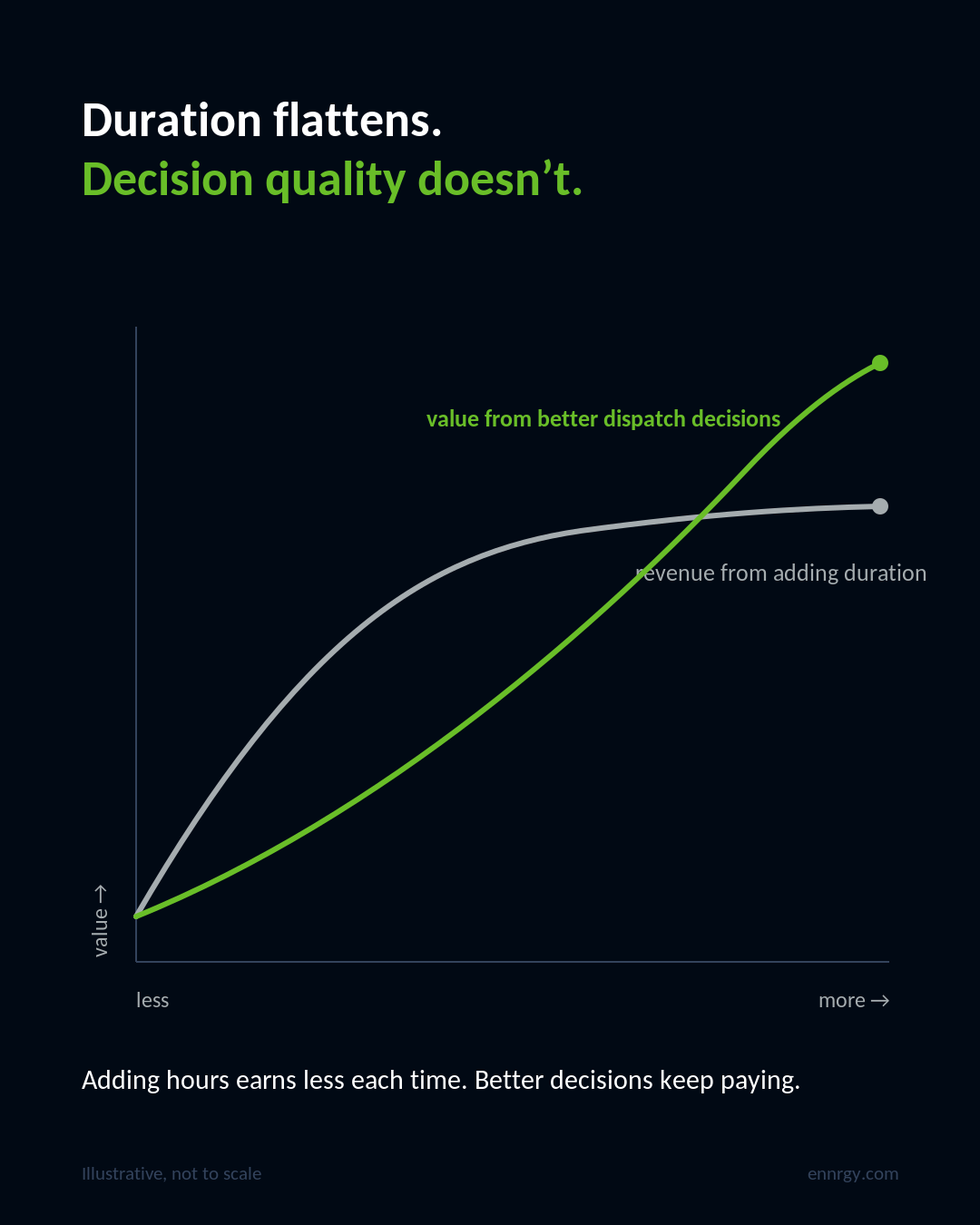
Longer batteries do earn more, and the reason is the tell. Two-hour battery energy storage systems (BESS) have out-earned one-hour systems every month for two years, by 15% to 81%, and Modo Energy is clear about where that premium comes from: energy arbitrage, not ancillary services. Over the trailing year, two-hour systems earned roughly twice the energy revenue of one-hour systems. A longer battery reaches wider, multi-hour price spreads; a one-hour system can only grab the single highest-priced hour.
That points at the deeper shift. Ancillary-services payments once made up most battery revenue in ERCOT. As the market saturated, those payments compressed, and energy arbitrage became the primary driver of fleet revenue (Modo Energy). The grid used to pay batteries for showing up. Now it pays for the quality of their dispatch. And arbitrage revenue is finite: every hour of storage added to the system is competing for the same pool of spreads, so each incremental hour tends to earn less than the last, even when a longer battery still earns more in total.
That's worth sitting with, because it changes what a battery is actually worth.
The part the curve leaves out
Duration and siting models are built for development economics. Where to site the asset, how long to size it, what the node might pay. The forecast runs up to the day the battery is energized, and then it hands the asset off to the operator and the developer's own cost model. After commercial operation, when revenue is made or missed in each interval, that whole workflow has left the building. The chart told you whether to build. It has nothing to say about how the thing runs on a Tuesday afternoon in August.
Behind the meter, the same curve reads better
Behind the meter (BTM), a home or commercial battery is one distributed energy resource (DER) among thousands. The one that looks oversized for arbitrage is correctly sized as a hedge. It sits at the meter and absorbs the exact hours that set the customer's bill. Its value stops scaling with duration and starts scaling with decision quality, one meter at a time, across the whole fleet.
That's the real game once the assets exist, and it's the difference between a pile of batteries and a working virtual power plant (VPP). Not how many hours you built, but what is deciding when each battery charges and discharges, right now. Thousands of DERs aggregated into a VPP but running the schedule someone set at installation are leaving most of their value in the garage. The battery is smart. The schedule usually isn't.
Which makes it an operations problem
Doing better comes down to operations, the domain of battery dispatch optimization software rather than bigger hardware. The hardware is already on the wall. It means load forecasting at each individual meter rather than off a class average. It means dispatching through direct API control and confirming the instruction actually executed, instead of filling in time blocks on a portal. It means a manufacturer-agnostic approach that works across whatever OEMs and connectivity platforms are already installed. And it means every charge and discharge landing in the same system where the positions, hedges, and settlements live, so a battery that earns money the back office can't see still counts as earning it.
The duration curve is a good tool for deciding what to build. Once it's built, a different question runs the economics: what is deciding its dispatch, interval by interval? That's the one worth answering.
ennrgy.com's Asset Optimizer runs AI-powered behind-the-meter battery and BESS optimization for virtual power plants and distributed energy resources, live in ERCOT. See how it works. We track DER and battery storage developments every day on our Power & Gas News page.
See how VPP optimization works
From meter-level forecasting to real-time dispatch. The full ADER use case in ERCOT.