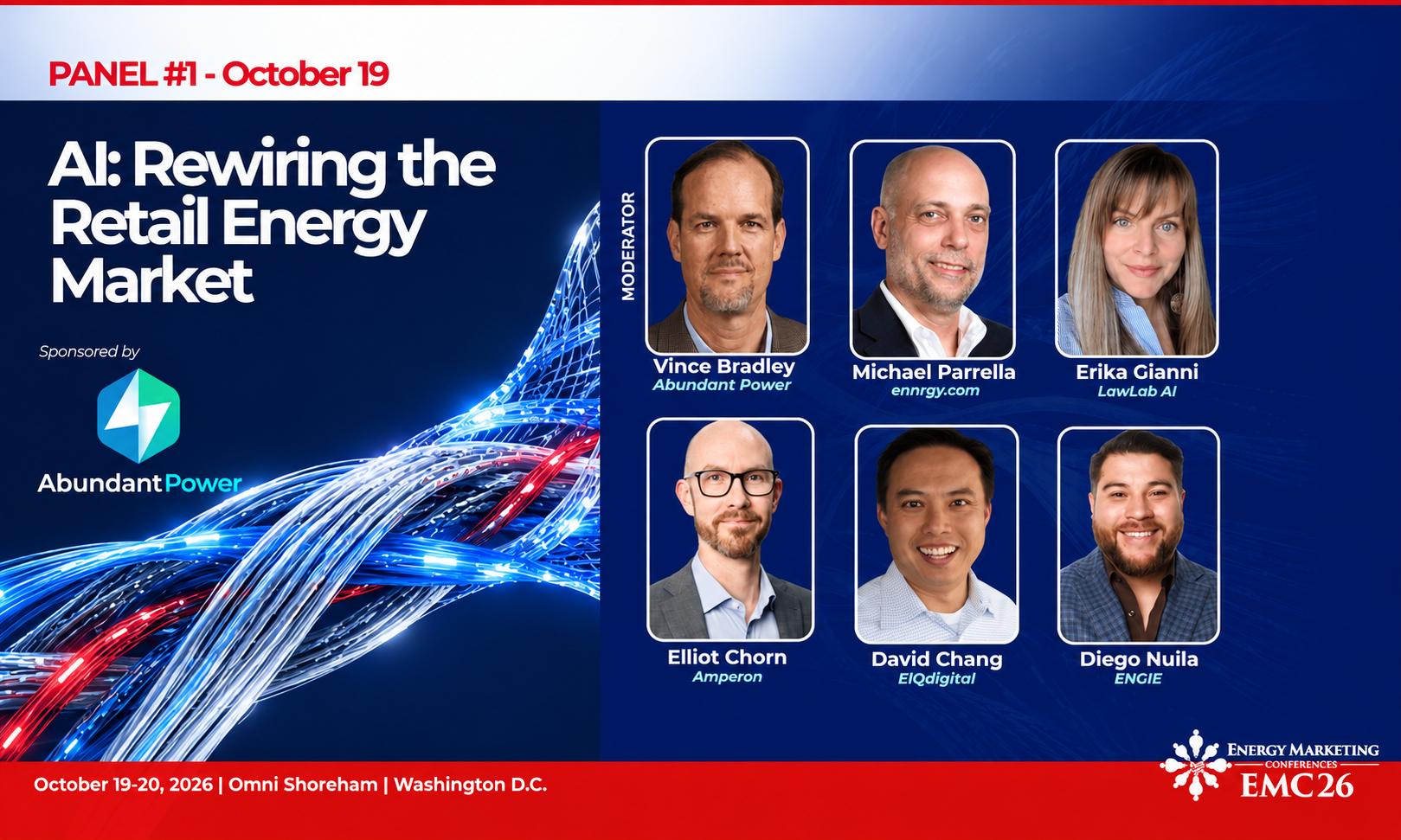
Last week at EMC26 I sat on a panel called “AI: Rewiring the Retail Energy Market.” Vince Bradley of Abundant Power moderated, and I shared the stage with Erika Gianni of LawLab AI, Elliot Chorn of Amperon, David Chang of EIQ Digital, and Diego Nuila of ENGIE. Vince framed it well from the start: AI shows up in our industry as a tool and as a problem, and we needed to talk about both. Here’s what stuck with me.
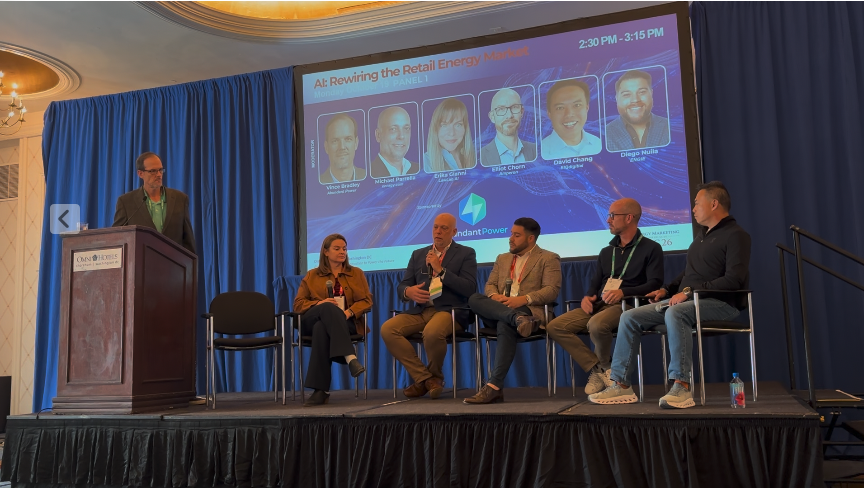
The panel on stage at EMC26, Omni Shoreham, Washington DC. October 19, 2026.
We’re Not in Kansas Anymore
David opened by asking the room how many people knew the difference between generative AI and agentic AI. About half the hands went up. That gap matters. A chat assistant helps a person do a task. An agent does the task while the person manages it.
A group of CEOs I meet with realized we needed to spend as much time on culture as on technology, so we split our sessions in two. Then I held an all-hands with my own team, and it felt like a Wizard of Oz moment. You wake up and the twister has taken everything you knew. A software developer now spends the day talking with agents about the code, tests, and architecture they want. The people who thrive adapt to that mindset quickly.
Pick a Spot and Get It Rolling
My answer on where a retail supplier should start: it’s easier to steer a bicycle once it’s rolling. Don’t stand still. Pick something, experiment, and follow it where it leads. The panel agreed you start with real problems and clean, governed data. I’d add one step. Before you build anything, use the generative tools to find the patterns in your problems and light up the points of attack.
David’s version was “don’t let perfect be the enemy of good.” Diego shared an ENGIE enrollment workflow where AI reads the documents and the team reviews and validates, taking enrollment from three or four days to under one.
We Sell a Commodity
Here’s the not-so-secret truth. Energy companies sell commodities. Our value is getting a customer to a quality agreement faster, keeping it that way for the life of the customer, and lowering cost to acquire and cost to serve. I used to fight for engineering resources to build the tooling I needed. Now much of it gets built over a weekend, as long as the data foundation comes first.
Another shift is coming. As agents move into people’s homes, ChatGPT or Claude reads your website before a human does, then brings a recommendation back. Who are you designing your experience for?
Remove the Fear, Keep the Guardrails
The panel flagged two risks: agents get too much access too easily, and the technology outruns how fast organizations can adapt. Governance and controls answer both. Then remove the fear of failure. Mistakes are far cheaper to fix than they used to be, so arm people with the tools and let them try again.
The Questions Nobody Can Answer Yet
The “AI as a problem” half was about load. Nobody knows how much of the data center pipeline will connect, where or when, and ERCOT’s move from 4CP toward 12CP shows the cost allocation is already shifting. Inside our companies, the hard part is orchestration: getting data, talent, and process working together instead of in silos.
What scares me most is that we’re making long-term decisions about how to fund and power all this responsibly, and none of us has a monopoly on the truth. Raise your hand if you know what happens in two weeks. That’s why load forecasting, disciplined hedging, and accurate settlement matter more than ever.
A Call to Arms
Near the end, a question from Constellation pointed out that only about 14 states let customers choose their supplier. I closed with a challenge to the room, and I’ll repeat it here:
At varying times I’ve been either happy or embarrassed to be in this industry. Sometimes we do things great, and sometimes we take advantage of customers. With the tools and the inflection points in front of us right now, we have the chance to make ourselves the example and lead the other states into what should be done. If we do that, this industry will survive and thrive. If we don’t, we start a spiral. Take the tools, add value to your customers’ lives, and don’t take advantage of them. We have to lead now.
Thought Starters
• What would it take for retail choice to be the model other states want to copy?
• If your customers send AI agents to shop for energy, is your website ready to talk to them?
• Which repetitive back-office task would you hand to an agent first, and who would manage it?
• How are you pricing data center load uncertainty into the contracts you sign today?
Let’s Keep Talking
If you’re a retail supplier working out where AI fits, I’m happy to compare notes. At ennrgy.com we help suppliers put AI to work across load forecasting, hedging, and settlement, and we run AI behind-the-meter battery optimization that’s live in ERCOT today. Our shorthand for it is moving from a system of record to a system of action.
If any of that is on your list, reach out. You can also see how the platform fits together, or read more about our VPP and battery work.
Mike Parrella is CEO of ennrgy.com and Softsmiths.
From System of Record to System of Action
See how ennrgy.com puts AI to work across load forecasting, hedging, settlement, and behind-the-meter battery optimization.