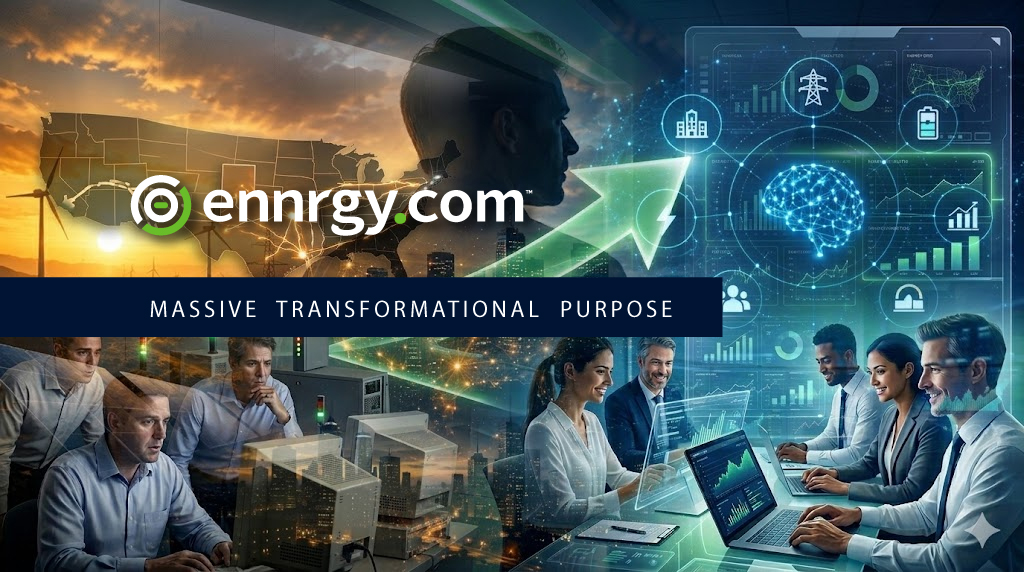
In 2014, Salim Ismail coined a term in Exponential Organizations that stuck with me. He called it the Massive Transformational Purpose.
The idea is simple. Your MTP is the dent you want to make in the world. It’s deliberately too big for any one company to finish.
And that’s the point: it creates pull. The right people show up. The right decisions get easier.
A mission describes what you do. An MTP describes why any of it matters.
That difference sounds subtle until you’re trying to merge 2 companies.
I’ve read plenty of mission statements in my career. Most describe products and market position. They work fine when you’re running one company.
But when you’re combining organizations, everything shifts. An MTP holds because it’s about impact.
When you know the purpose, it filters every decision. Who to hire. What to build.
Two companies, one north star
For 10+ years, SoftSmiths built energy trading and risk management software. We served dozens of retail energy providers across the deregulated US markets.
Good at it. Defined by it.
Then in February 2026, we brought Risk360 into the family under Banyan Software. JC Swartz and his team had spent years earning the trust of 55+ retail energy suppliers across every ISO and RTO in the country.
PJM, ERCOT, NYISO, ISO-NE, MISO, SPP, CAISO. All 7.
They’d built those relationships by sitting inside their clients’ operations: scheduling, nominations, settlements, compliance. The work that keeps the lights on and the margins intact.
So we had SoftSmiths with a decade of ETRM software, and Risk360 with deep operational relationships across every deregulated market in the US. Different histories, different strengths.
And when we sat down to figure out what we were building together, one thing was clear: we needed an MTP that matched the transformation we’re in the middle of as a company, and aligned with the transformation the entire energy grid is undergoing.
We’re still defining our MTP. That’s an exciting place to be.
The grid is changing faster than at any point in our careers. Our company is changing with it. The MTP we land on has to be bigger than either organization’s history. It has to pull us forward into what energy is becoming.
That search is what gave us ennrgy.com.
The market needs its own MTP moment
Here’s what I’ve been thinking about. The deregulated energy market is going through an identity crisis.
For years, the REP playbook was straightforward. Buy wholesale, hedge your position, set your rates, manage your margins.
Spreadsheets and good instincts. That worked when the grid was simpler.
But the grid got complicated. Fast. Distributed energy resources are everywhere.
Battery storage is reshaping supply and demand curves. Virtual power plants are turning residential rooftops and garage batteries into dispatchable assets.
ERCOT alone has seen a surge of DER participation in the last 2 years.
REPs are making decisions that didn’t exist 5 years ago. How do you price against a competitor whose cost structure includes battery arbitrage revenue? How do you model risk when your supply curve includes intermittent solar and behind-the-meter storage?
Cooperatives face a different version of the same question. A co-op in the Midwest might have members installing rooftop solar and home batteries. The business model for aggregating those assets into a VPP is still being written.
A few years ago, most co-op boards hadn’t heard the term “virtual power plant.” Now they’re evaluating whether to build one.
Every corner of the deregulated market is hitting the same wall. The complexity outgrew the tools.
Survival and thriving both require purpose
The companies that make it through this transition will be the ones that define their MTP clearly.
A cooperative might frame theirs around energy sovereignty: giving members real control, maybe even aggregating rooftop solar and home batteries into a VPP. A REP in ERCOT or PJM might anchor to pricing clarity their commercial customers have never had.
At ennrgy.com, we’re building toward that north star. Two organizations with combined decades of energy market experience, working under one roof for the first time.
Headroom Intel monitors 41 utilities and 168 rate codes daily so our clients can see exactly where they’re competitive. Our Asset Optimizer is live in ERCOT, working with Abundance Energy to dispatch battery assets against real-time market conditions.
Our managed ARR bidding captured $13.4 million in value last year at 97.25% of the theoretical maximum. Our Expert Managed Services team runs scheduling and settlements 365 days a year for clients who’d rather focus on their customers.
Every one of those capabilities points in the same direction. When we land on our MTP, it’ll tie them all together.
Start the conversation
Ismail wrote that an MTP creates “cultural glue” that holds organizations together through rapid change. In an industry being reshaped by DERs, batteries, VPPs, and shifting regulations, that glue matters.
It’s what pulled SoftSmiths and Risk360 together. It’s what keeps our team focused when the product roadmap gets long. And it’s what we’re working to articulate right now.
If your organization hasn’t defined its MTP, start that conversation. The companies that know why they exist make better decisions about what to build next.
And in energy, the decisions are only getting harder.
If any of this resonates, I’d like to hear how you’re thinking about purpose in your organization. Reach out at mparrella@softsmiths.com or connect with us at ennrgy.com.
See What ennrgy.com Is Building
From competitive rate intelligence to real-time battery dispatch, we’re giving energy companies the visibility to act with confidence.