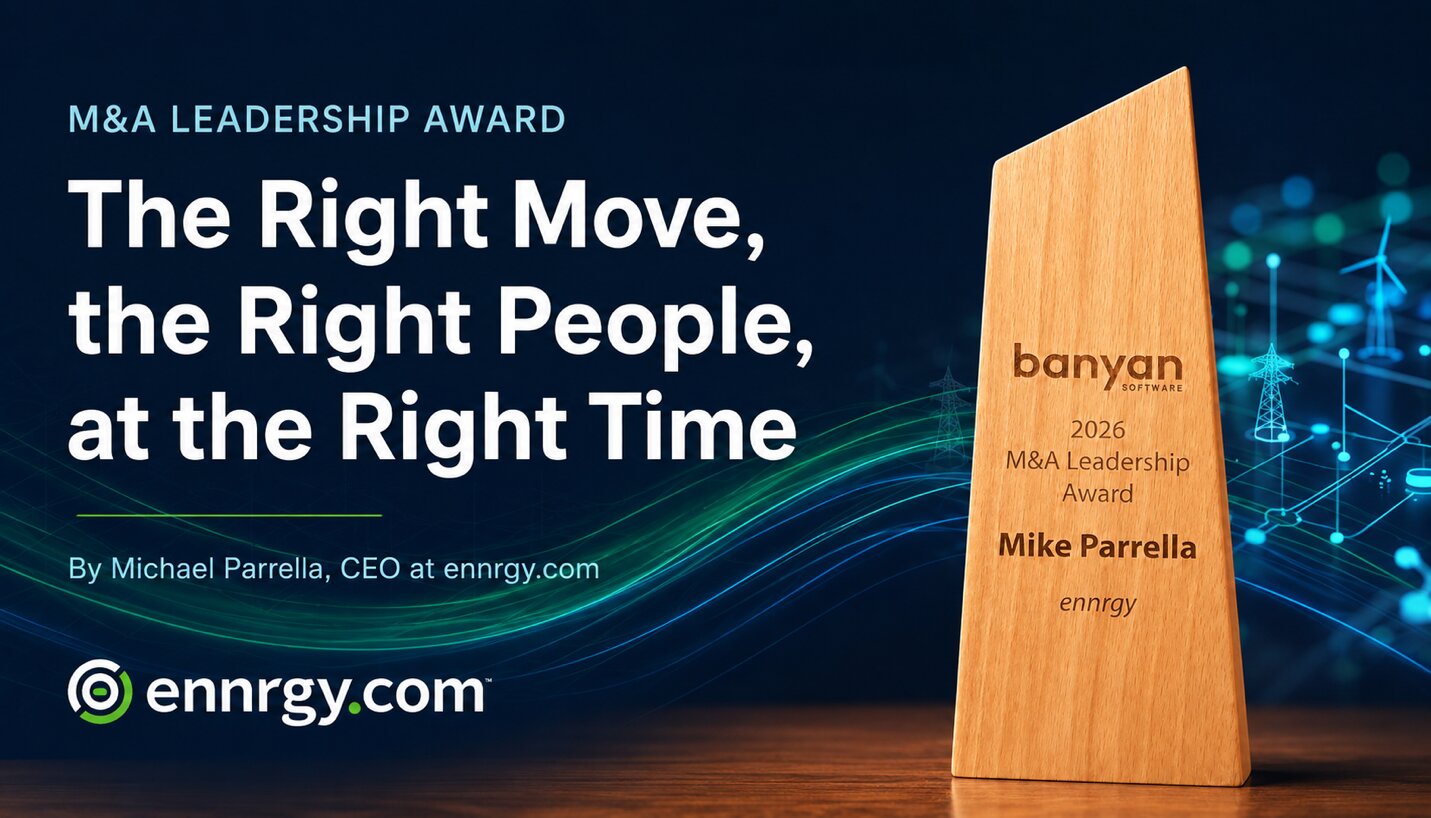
Last month at Banyan Software’s CEO Summit in Toronto, I accepted an M&A leadership award in a room of about 125 portfolio company CEOs. The theme was resourcefulness under pressure — the ability to build from what you have when the situation demands it.
I’m grateful for the recognition. And I’ve spent the time since thinking about what the award actually represents — because the answer is bigger than one deal.
More than the sum of the parts
The award centers on an acquisition I pushed for, had rejected, reframed, and ultimately closed with Banyan’s backing. It’s performing well.
But if I’m being honest, the deal was the easy part. The hard part — the part that doesn’t fit neatly into an award narrative — was the work our people did after the ink dried.
On paper, this merger combined two companies. In practice, it was more like 1 + 1 = 10. We came into it with more than 200 combined years of energy market expertise across trading, scheduling, risk management, and operations. These aren’t people who read about energy markets. They’ve lived in them — managing books through polar vortexes, navigating FERC filings at 2 a.m., building hedging strategies that kept companies solvent when their competitors went under. The acquisition brought a team of engineers and product builders who think in algorithms, not slide decks — people who had already been pioneering AI-native approaches to problems most of the industry was still solving with spreadsheets.
Put those two groups in the same room and something happens that neither team could have produced on its own. Energy veterans who know exactly what a 15-minute dispatch window means to a REP’s P&L start working side by side with engineers who can build the AI optimization model to capture it. The people who’ve spent decades understanding why a decision matters are now paired with the people who can automate how it gets made — thousands of times a day, at every meter, without a human bottleneck. That combination doesn’t just add capability. It multiplies it.
Risk360 is ennrgy.com’s system of record: load forecasting, risk management, portfolio hedging, and settlements, all on one platform. Asset Optimizer is the system of action: AI-powered battery dispatch that turns a fleet of distributed energy resources into a coordinated margin engine. These two halves work together in a way neither could deliver alone — and the team that built the bridge between them is the reason the math came out to ten, not two.
The award recognized the judgment to see that combination coming. What makes me proud is the team that turned the bet into a product.
The grid doesn’t need more power. It needs more intelligence.
Timing in energy markets is everything. You can build the right product at the wrong moment and it doesn’t matter.
We’re not in that position.
Here’s a number that should bother everyone in this industry: the average utilization of the U.S. grid — the grid that ratepayers have already paid for — is less than 50%. The system is congested for a handful of hours and idle for most of them. We have $1.4 trillion in capital expenditures planned through 2030, rate increases running as far as the eye can see, and a transmission and interconnection queue that stretches years into the future. Gas turbines are sold out through 2031. High-voltage transformer lead times run 160 to 200 weeks. New thermal generation takes five to seven years from permit to power.
Battery energy storage systems? Twelve to twenty-four months from interconnection to online. ERCOT alone has gone from roughly 8.6 GW of installed BESS capacity at the end of 2024 to over 16 GW today — battery storage now represents 19% of ERCOT’s peak capacity. In PJM, that number is 0.2%. That gap is the single widest structural divergence in the U.S. power market, and it tells you everything about where this is headed.
The grid has a rush-hour problem. Everyone’s trying to jam more power through the same wires at the same time. What batteries do is the equivalent of a reverse commute — they absorb energy when the system is idle and deliver it when the pipes are full. You don’t need to build more infrastructure. You need to use what’s already there more intelligently.
That’s not a technology problem. It’s a coordination problem. And it’s exactly the kind of problem we built ennrgy.com to solve.
Behind the meter is a business model, not a product category
Here’s the insight that changes the conversation: behind-the-meter storage is not arriving as a hardware market. It’s arriving as a retail energy supply business model.
Look at the companies winning in this space. They’re not battery manufacturers who bolted on a retail license. They’re retailers who figured out that owning the battery — or at least controlling its dispatch — lets them capture value that a pure supplier never could: the capacity obligation, the physical hedge, and the customer relationship, all in one. The DER revolution the industry has been talking about for a decade is finally here, and it’s being led by energy companies, not equipment vendors.
Some of those retailers will build their own behind-the-meter BESS capacity. Most won’t. The ones who don’t will need someone to supply the intelligence layer — the per-meter, real-time optimization that turns a fleet of residential batteries into a virtual power plant that actually performs. That’s the opening.
And that’s exactly what Asset Optimizer was built for. It doesn’t manage batteries in aggregate. It manages them individually — every 15 minutes, every meter, using AI that learns from market conditions, weather patterns, load shapes, and grid signals to make dispatch decisions no human team could replicate at scale. And because it connects directly to Risk360, every dispatch decision flows into the same platform where the REP is managing positions, hedges, and settlements. The system of action talks to the system of record. The back office sees what the battery is doing, in real time, and understands what it means for the book.
That connection — behind-the-meter intelligence feeding directly into enterprise risk management — is where we believe the VPP space is headed. Most of the industry is still treating battery optimization and energy trading as separate problems, handled by separate teams with separate tools. We’re not. We built ennrgy.com to treat them as one problem, because that’s what they are.
We already have a live Asset Optimizer client in production. We’re not talking about what we plan to build. We’re operating. And every week of real-world dispatch data makes the AI sharper and the case for this approach harder to argue with.
Proof, not a finish line
Third-party validation from 125 peer-level operators means something different than a press release. These are CEOs who understand what it costs to build in hard markets. When ennrgy.com appeared in four separate presentations at the summit, including the CEO’s opening keynote, it wasn’t because of marketing. It was because the product story holds up under scrutiny from people who run companies for a living.
The award tells me we’re on the right track. It doesn’t tell me we’re done.
We don’t need to be everywhere at once. We need to find the spots where the market is ready and the customers are investing, and hit those spots. ERCOT is there today. Other markets are lining up behind it. As each domino falls, we’ll be positioned — not scrambling to catch up, but already operating, already proving it out, already smarter from the dispatch data we’ve been collecting.
We have a platform built around the belief that no one should make a high-stakes energy decision in the dark. We have an AI-native engineering model that’s accelerating. We’re pioneering behind-the-meter intelligence in a market where most participants are still figuring out how to connect their BESS fleet to their back office. And behind all of it, we have a team of people who genuinely care about this industry — who chose energy because the problems are hard and the stakes are real, not because it was the easy path.
I didn’t build any of this alone. The people at ennrgy.com did. I’m proud to work alongside them, and I’m more focused than ever on what we build next.
Ready to see what ennrgy.com is building?
From risk management to AI-powered battery dispatch — one platform, one team.