Post 1 of 5 in our VPP series
Residential batteries are showing up across retail energy books at a pace few predicted two years ago. The hardware is getting cheaper. Fleet software handles the routing. And yet most VPPs still underperform against their projected returns.
The hardware isn’t the bottleneck.
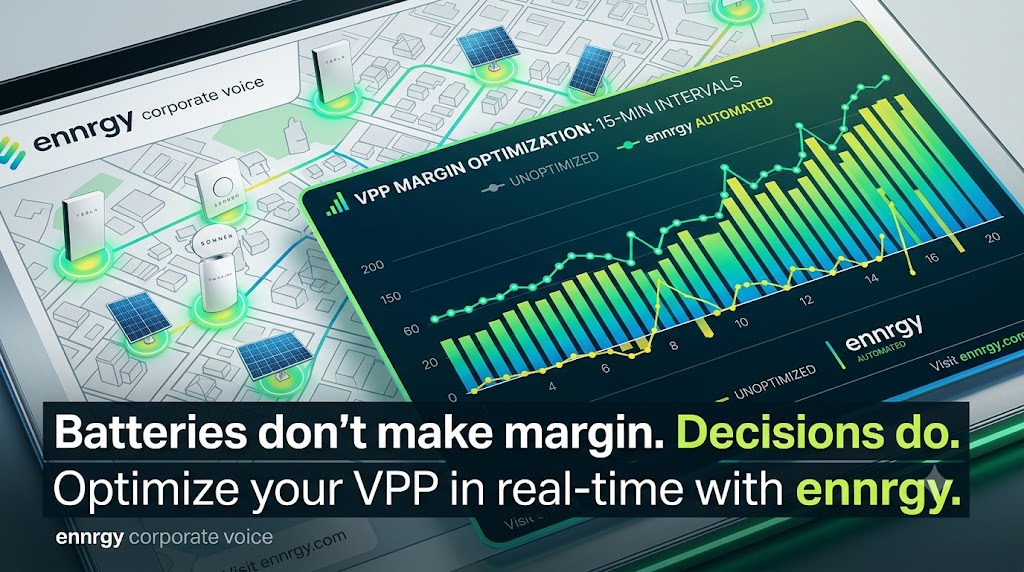
The margin in a residential VPP isn’t in the battery itself. It’s in the 15-minute decision to charge or discharge. Get that decision right across tens of thousands of meters, and you’ve got a real revenue stream. Get it wrong, or leave it to a team of analysts pulling levers by hand, and you’re leaving money on the table every dispatch interval.
Most REPs entering distributed storage are discovering this gap after the fact.
The problem with manual dispatch
Think about what it takes to optimize a fleet of 50,000 residential batteries by hand. Someone has to watch day-ahead prices, real-time prices, weather forecasts, generation forecasts, and grid-constraint signals, all at once, for every meter, every 15 minutes, around the clock.
It can’t be done. And when you scale to the fleet size that actually moves the needle on your book, the problem compounds.
That’s the gap between enrolling assets and earning from them. Enrollment is a customer conversation. Optimization is an operations problem, and the two require different tools.
What a VPP actually needs to earn
The margin in a residential battery fleet lives in the 15-minute price slice. Day-ahead prices signal where the opportunity is. Real-time prices confirm it. Grid constraints shape it. Load and generation forecasts frame the net position.
A fleet that earns consistently is one where all of those inputs feed into automated dispatch decisions, per meter, continuously. The battery charges when it should and discharges when it should, based on your strike prices and your strategy, without anyone having to intervene.
Fleet platforms do the routing. They move the command to the device. The decision about what command to issue, and when, based on current and projected market conditions, is a different function. That’s the optimization layer. It sits above the fleet software and below your back office, and it’s where the margin is actually made.
What this means if you’re already running a fleet
If your VPP is dispatching based on scheduled rules, time-of-use blocks, or manual analyst decisions, you’re leaving precision on the table. The market moves in 15-minute intervals. Schedules built days in advance don’t capture that.
The REPs earning consistently from distributed storage have automated that decision process. They’ve defined their strategy, set their parameters, and let the system execute against current market conditions without a team managing each dispatch.
Your batteries can do that job. The question is whether the system directing them is built to do it.
Want to see what automated optimization could mean for your fleet?
The ennrgy team models your book against real ERCOT data before any integration. Reach out at info@ennrgy.com to start the conversation.