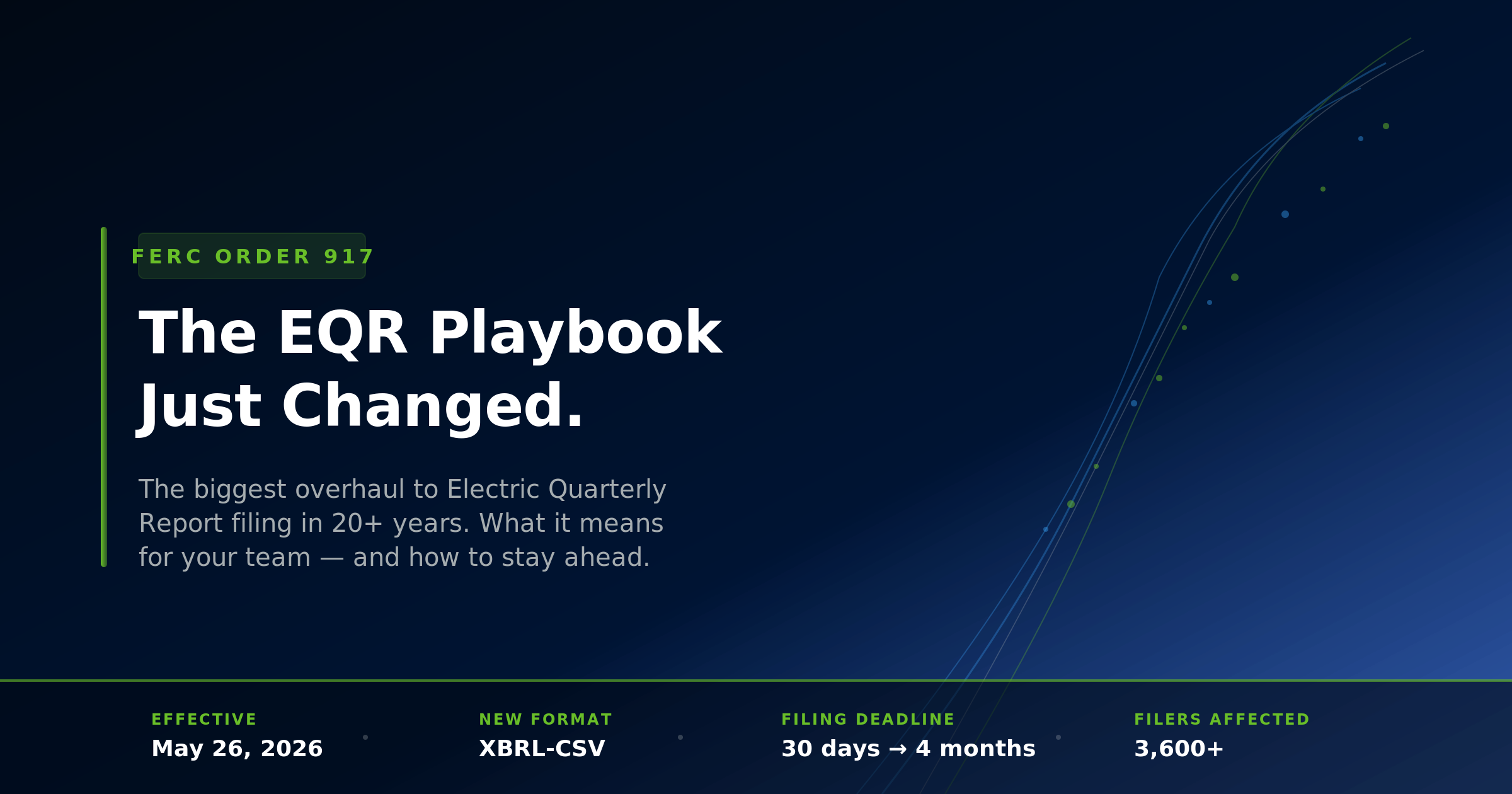
FERC Order No. 917 is the biggest overhaul to Electric Quarterly Report filing in over 20 years. If your team handles EQR submissions, the clock is already ticking.
On March 19, 2026, the Federal Energy Regulatory Commission issued Order No. 917 — a sweeping final rule that fundamentally changes how Electric Quarterly Reports are filed, formatted, and processed. The rule takes effect May 26, 2026, and while the full rollout will unfold over the next 12 to 24 months, the implications are immediate.
If you're one of the 3,600+ entities that file EQRs with FERC, this isn't a minor policy tweak. It's a ground-up rework of the filing process your team has relied on for two decades.
Here's what changed, what it means, and how to stay ahead of it.
The Filing Format You Know Is Going Away
FERC is replacing the legacy XML-based filing system with XBRL-CSV (eXtensible Business Reporting Language — Comma-Separated Values) as the sole submission standard. The old methods — XML uploads, manual data entry through the EQR portal — are being phased out entirely.
For teams that have spent years building internal processes, spreadsheets, and workarounds around the current format, this is a significant disruption. Every ISO produces data in a different format. Your team has to compile, reformat, validate, and submit — and now the target format itself is changing.
If you've been doing this manually, the complexity just multiplied.
More Time, but More Complexity
There is one piece of welcome news: FERC extended the filing deadline from 30 days after the quarter to four months. That extra runway helps — particularly because it allows more time for settlement data to finalize, which should reduce the volume of refilings.
But don't mistake a longer deadline for a lighter workload. The shift to XBRL-CSV means your team needs to learn a new format, rebuild validation processes, and adapt to a fundamentally different submission workflow. And if you're operating across multiple ISOs — PJM, MISO, CAISO, ERCOT — you're still reconciling data from different sources in different formats, just into a new target.
ISOs and RTOs Now Have Reporting Duties
Under Order 917, ISOs and RTOs must produce quarterly transaction data reports for their market participants. That data becomes the authoritative reference point for organized-market transactions in EQRs.
In theory, this simplifies things — your ISO provides the transaction data, and you incorporate it. In practice, the ISOs need to get on board with the new formatting first. Until they do, there's a gap between what the rule requires and what's actually available to filers. That transition period is where mistakes happen.
The Refiling Window Stays at Three Years
FERC kept the default refiling period at 12 quarters, but made a point of clarifying that it reserves the right to require refilings beyond that window in exceptional circumstances. So while the baseline hasn't changed, the Commission signaled it's watching more closely.
What Happens If You Get It Wrong
FERC's portal rejects non-compliant submissions outright. You fix the error, resubmit, and hope nothing else surfaces. If you miss the deadline, FERC issues warnings. If it keeps happening, the scrutiny escalates.
The real cost isn't the penalty — it's the time. Teams that handle EQR filings manually describe the last two weeks of every filing month as nonstop work. Multiple ISOs, multiple formats, manual reformatting, portal rejections, resubmissions. It pulls your people away from revenue-generating work and puts them in a reactive cycle that repeats every quarter.
Now layer a format migration on top of that.
This Is Exactly the Kind of Shift We Built For
At ennrgy.com, we've been handling EQR filings for energy suppliers for years. We know the pain — the ISO-by-ISO data wrangling, the formatting mismatches, the portal rejections that don't tell you everything on the first pass.
That's why we built an automated EQR filing process that handles the compilation, reformatting, and validation across ISOs. When FERC changes the rules, we adapt the system. Our clients don't have to retool their internal processes or retrain their teams. They just keep running their business.
Order 917 is a big change for the industry. For our clients, it's part of the process — one less fire drill every quarter.
Don't Wait for the Deadline to Start Planning
The rule is effective May 26, 2026. The transition to XBRL-CSV and ISO-provided transaction data will roll out over the following 12 to 24 months. But the time to assess your readiness is now — not when the first filing under new rules is due.
Whether you're currently managing EQR filings in-house, working with a manual process, or just starting to realize the scope of what's coming, we'd like to help you think through it.
Book a discovery call and let's talk about how your team can navigate Order 917 without the fire drill.
Let us handle your EQR filings.
See how ennrgy.com automates EQR compliance across every major ISO — so your team can focus on the business.
Learn About Our EQR Filing Services →